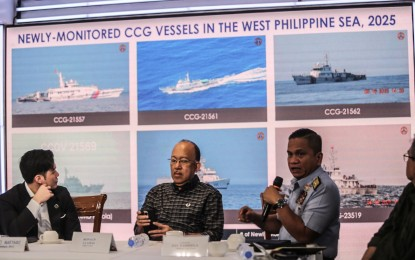
MANILA – A political analyst on Saturday said the Chinese Embassy in Manila’s repeated criticisms of Philippine Coast Guard (PCG) spokesperson for the West Philippine Sea, Commodore Jay Tarriela and other Filipino officials run counter to the Vienna Convention on Diplomatic Relations.
Speaking at the Saturday News forum in Quezon City, Ronald Llamas said the embassy’s social media attacks against Tarriela amount to a violation of Article 41 of the Vienna Convention, which requires foreign diplomats to respect the laws of the host country and refrain from interfering in its internal affairs.
“Iyong ganoong klaseng lengwahe, ‘yung ganong klaseng atake ay hindi atake sa isang tao. Hindi atake iyon kay Jay. Atake iyon sa ating bansa dahil spokesperson siya ng isang mahalagang institution ng ating bansa, ang ating Coast Guard, ang ating (That kind of language, that kind of attack is not an attack on one person. That is not an attack on Jay. That is an attack on our country. He is the spokesperson of an important institution of our country, our Coast Guard, our) security sector,” he said.
Article 41 states that officials and members of diplomatic missions, without prejudice to their privileges and immunities, must “respect the laws and regulations of the receiving State. They also have a duty not to interfere in the internal affairs of that State.”
A similar sentiment was aired by Akbayan party-list Rep. Chel Diokno on Friday night and called on the Department of Foreign Affairs to intervene.
“The Chinese Embassy’s attacks on our officials — particularly Senator Kiko Pangilinan, Congresswoman Leila de Lima, Rear Admiral Roy Vincent Trinidad, Philippine Coast Guard Commodore Jay Tarriela, and the National Maritime Council — constitute a clear violation of Article 41 of the Vienna Convention on Diplomatic Relations,” he said.
Since last week, Chinese Embassy Deputy spokesperson Guo Wei and Tarriela have been trading barbs over developments in the West Philippine Sea, with Tarriela describing Beijing’s posture as “more aggressive, confrontational, and vocal.”
The embassy dismissed as “wrongful and groundless” statements by lawmakers, including those of ML Party-list Rep. de Lima, who earlier criticized China’s actions in the South China Sea.
On Friday, the Chinese Embassy again rebuked Tarriela, accusing him of “hyping up maritime issues” and “misrepresenting facts,” and disclosed that it had filed a diplomatic protest against him over an alleged smear of Chinese leaders linked to a circulated cartoon resembling Chinese President Xi Jinping.
“There is no authority for the Chinese Embassy to ask us to explain,” Tarriela said during the same forum. “Why would I apologize, because of the caricature, iyon ba ang issue nila (Is that their issue)?”
“I didn’t even mention na si President Xi Jinping iyon. Sila nga ang nagpangalan doon. Secondly, sino ba ang mga caricature na ginawan na rin nila na mga national leaders? Ang intention talaga ng embassy is to justify ‘yung panawagan nila (They are the ones who made the label. Secondly, don’t they also have a caricature of other national leaders? I think the intention of the embassy is to justify their call) to silence me, I think,” he added.
For weeks, Tarriela said the embassy had been downplaying Chinese presence in the West Philippine Sea and “amplifying their lies and misinformation” about the area and the 2016 Arbitral Award.
“I don’t think there’s a need for me to apologize to the Chinese Embassy,” he said. (PNA)